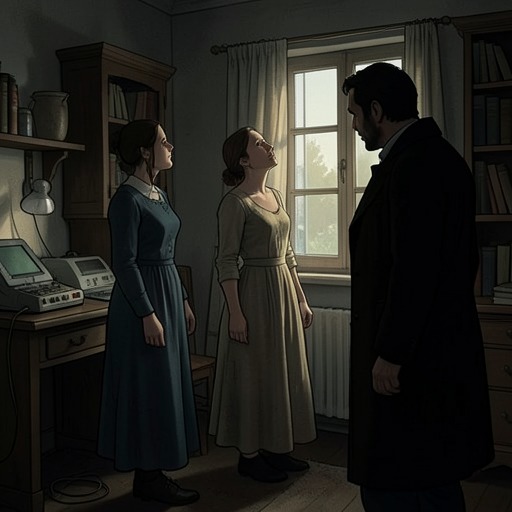
La Thénardier
Les MisérablesLa Thénardier is the innkeeper whose care of Cosette becomes a source of both financial exploitation and direct cruelty. Introduced as one half of the couple running an inn at Montfermeil, she is first approached by Cosette’s mother as a possible caregiver. Years later, Cosette is still in her household, but the contrast between the child’s desperate condition and the innkeeper’s demands reveals the human cost of that arrangement.
Identity and the Inn
In the spring of 1818, La Thénardier and her husband run an inn in Montfermeil, near Paris, in an alley called Boulanger. Its sign advertises the Sergeant of Waterloo. The painted scene shows a man carrying another man with a general’s epaulettes, against a smoky, battle-like background. The sign gives the establishment a martial identity, while the inn itself is the ordinary setting in which two mothers’ circumstances briefly meet.
La Thénardier identifies herself as the mother of the two little girls at the inn and says that she and her husband keep the establishment. The girls, about two and a half years and eighteen months old, sit together on a chain hanging beneath the axle of a vehicle, secured by a knotted handkerchief. The precarious makeshift swing is an early, concrete picture of the children’s surroundings. It is the sight of them that catches the attention of Cosette’s mother, who has come to the inn carrying her own small child.
The narrator describes La Thénardier as red-haired, heavy-bodied, and angular, with the appearance of a soldier’s wife. Her manner combines a masculine bearing with an affected, sloping air associated with her reading of old romances. She is not yet thirty. The narrator remarks that, had she been standing rather than seated at the threshold, her height and broad build might have alarmed the traveler and altered what followed. Her posture thus becomes more than physical description: a small circumstance helps make possible the confidence on which the encounter depends.
The Encounter with Cosette’s Mother
La Thénardier raises her head, thanks the woman who has noticed the children, and seats her on the bench by the door while remaining at the threshold herself. The two women talk. Cosette’s mother tells a modified version of her story: she is a worker whose husband has died, she has found no work in Paris, and she is walking to seek employment elsewhere, in her home region. She explains that she has carried her child, taken a carriage as far as Villemomble, and walked on to Montfermeil; her little girl has walked some of the way but has tired and fallen asleep.
When Cosette’s mother sees La Thénardier’s daughters and remarks on how naturally children seem to recognize one another, she takes La Thénardier’s hand and asks her to keep Cosette. La Thénardier responds with a startled movement that amounts neither to consent nor refusal. This hesitation matters: the later arrangement is not presented as an immediate, uncomplicated promise. The evidence instead places the request at the beginning of a relationship in which Cosette comes to live under La Thénardier’s roof, while the mother remains responsible for paying for her care.
Money and the Cost of Care
The arrangement becomes a recurring financial burden for Cosette’s mother. La Thénardier’s household raises its charge: the sum requested increases from six francs to twelve, then from twelve to fifteen. Meanwhile, Cosette’s mother earns little at the women’s workshop in the factory run by M. Madeleine. The work is new to her and she is not skilled at it, so she earns only a small amount each day, enough at first to live on but not enough to meet the mounting pressure without hardship.
The letters from the inn add to that pressure. They arrive frequently, distress Cosette’s mother, and cost money to receive. One says that Cosette is inadequately clothed against the cold and needs a wool skirt, asking her mother to send at least ten francs. After carrying the letter in her hands all day, Cosette’s mother goes to a barber and sells her long blond hair. The episode makes the demand’s consequence tangible: the child’s reported need is answered through the sale of her mother’s body, while the household’s repeated requests leave the mother with fewer resources of her own.
Cosette’s mother’s circumstances worsen after the secret that she has a child is discovered. More than a year after she has entered the factory, a supervisor delivers fifty francs on behalf of the mayor, tells her she no longer belongs to the workshop, and urges her to leave town. The same month, the inn raises its demand again. The fifty francs are not enough to pay her rent and debts, and she cannot simply leave. The evidence does not make La Thénardier responsible for the factory’s decision, but the timing places that dismissal alongside the inn’s escalating charges, tightening the pressures on the mother from separate directions.
Cosette in the Household
Years later, Cosette returns to the inn after a visitor has arrived to lodge there. La Thénardier appears at the door holding a candle and scolds the child for taking so long, accusing her of having stopped to play. Cosette, trembling, tells her that a gentleman has come to stay. The scene presents the child as answerable to La Thénardier before it presents her as someone receiving care.
When Cosette begs for mercy, La Thénardier unfastens the whip. Yet once the visitor has gone out, she takes the opportunity to kick Cosette hard enough to make her cry out. The child curls into a corner by the hearth, trying to gather and conceal her half-naked limbs. La Thénardier’s action is not simply a threat that frightens the child: the kick turns the apparent pause in punishment into another act of violence.
The visitor then returns carrying the large doll that Cosette has long seen displayed at the toy seller’s. He sets it upright in front of her and gives it to her. The doll’s arrival sharply opposes La Thénardier’s treatment of Cosette: where the innkeeper uses fear and force, the visitor answers the child’s vulnerability with a gift. The contrast makes visible how little the household’s nominal role as caregiver guarantees protection.
Narrative Role
La Thénardier’s significance rests on the widening distance between taking a child into the household and actually caring for her. Her first response to Cosette’s mother is hesitant, and later evidence shows the financial terms of the arrangement rising as the mother’s earnings remain slight. The letters convert the child’s needs into demands on a woman already struggling to support herself; Cosette’s later condition shows that the money extracted has not secured her comfort or safety.
The narrative also sets La Thénardier’s two scenes with children against each other. At the inn, her daughters sit together on the improvised chain swing, while Cosette’s mother looks at them and asks for help. Years later, Cosette stands inside the same household, exposed to scolding, a whip, and a kick. The movement from the first meeting to the later scene turns an apparently practical act of entrusting a child into an account of neglect and abuse, and places La Thénardier at the center of the separation between a mother’s sacrifice and a child’s daily life.